

This is not an opinion piece. It is not a collection of anecdotes, though there are many available. It is an attempt to lay out, as clearly and precisely as possible, what happens physiologically when equipment engineered for a male body is worn by a female one, repeatedly, for hours at a time under operational conditions.
The reason this matters is that the consequences have been treated, almost universally, as a welfare problem. They are not. They are a performance and health problem. And once they are understood as such, the case for a properly designed female operational kit stops being an equity argument and becomes an operational necessity.

The Starting Point: What Standard Body Armour Was Designed For
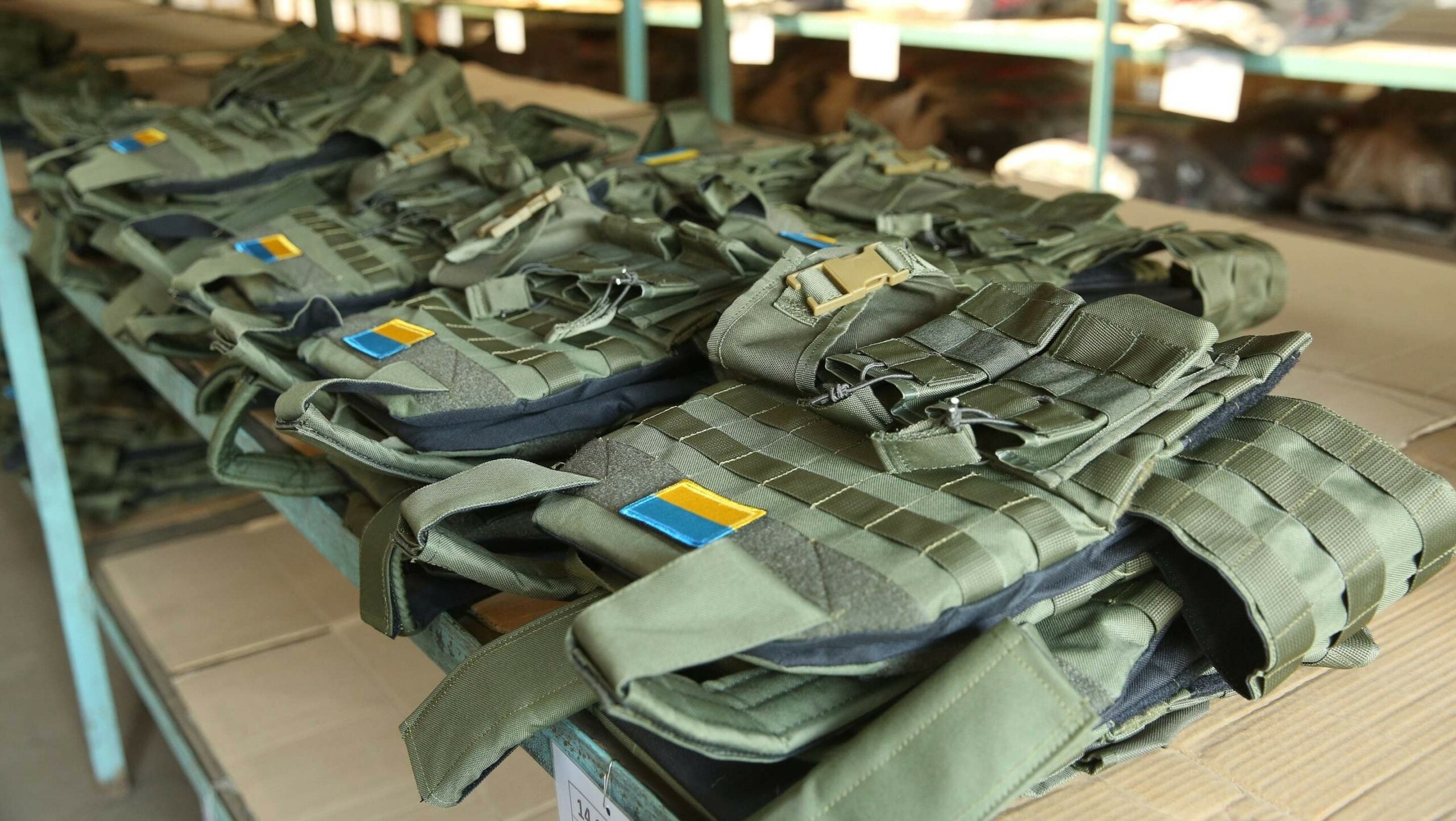
Standard military and law enforcement body armour, the kind issued as part of a standard kit, was designed around male anthropometric data. The plate geometry, the strap configuration, the chest-to-shoulder ratio, the torso length assumptions: all of these reflect decades of measurement data collected primarily or exclusively from male service members.
This is not a historical oversight that has since been corrected. As of 2024, the majority of body armour issued to female service members in most armed forces remains male-standard. In Ukraine, over 150,000 male-standard armour sets were purchased in 2024 alone, despite two female-specific designs being certified earlier that year.
The consequence is that female service members wear equipment built for a body that differs from theirs in several functionally significant ways; this causes consequences to their health, performance, safety – and it causes financial consequences through disability and medical payouts.
The Chest Plate Problem
The most immediate mechanical issue is the chest plate/plate carrier vest.
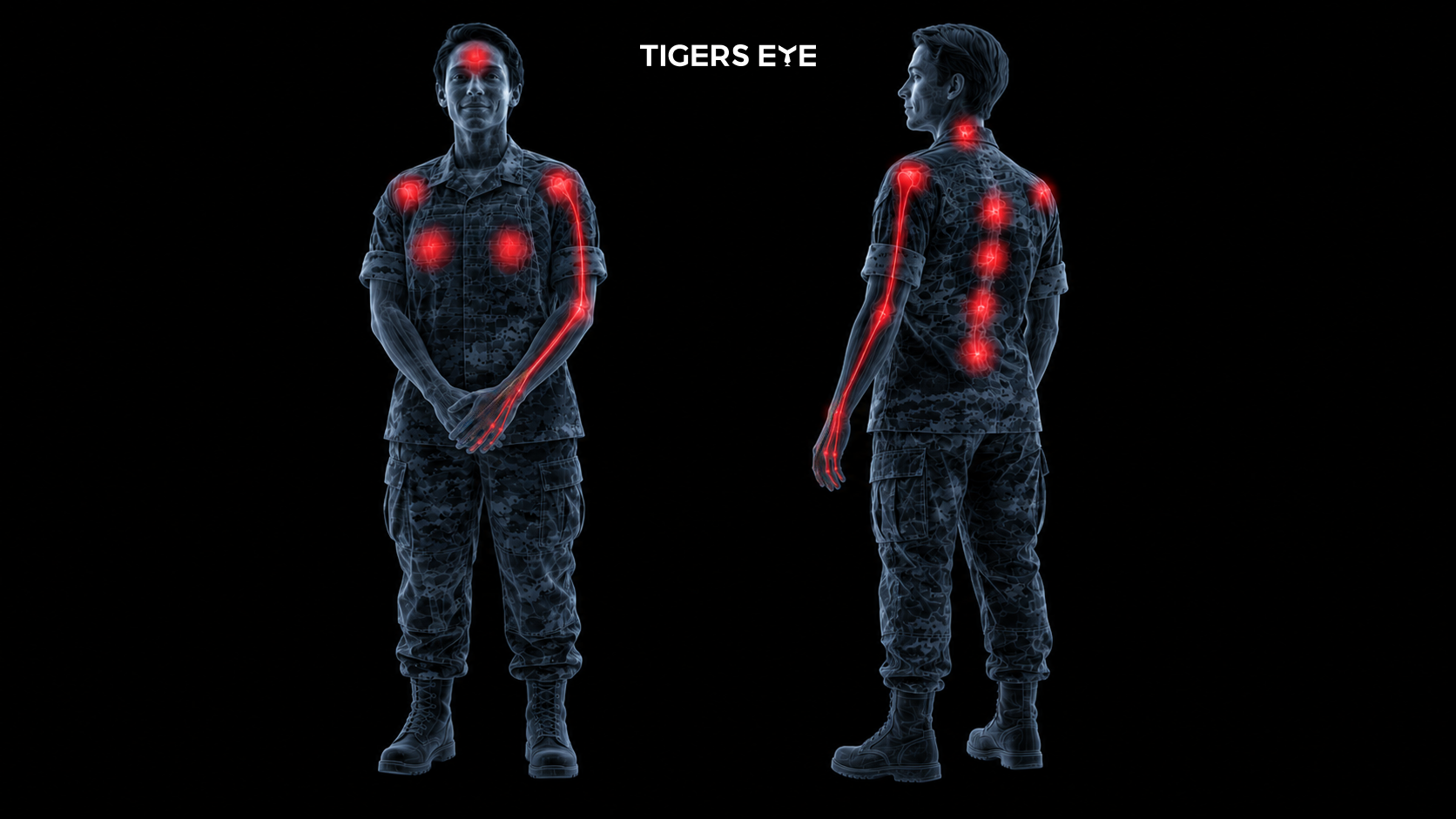
In male-fit armour, the front plate is designed to sit flat against a male chest, covering the sternum and the soft tissue on either side. On a female body, the chest is not flat. Breast tissue creates a convex surface that the flat plate cannot conform to. The result is that the plate either: (a) presses directly down on breast tissue, creating constant compression across the chest; or (b) sits at an angle, tilted outward at the bottom, which reduces the ballistic coverage it provides and shifts the weight distribution incorrectly onto the lower sternum and abdomen.
Neither outcome is acceptable. One creates chronic compressive injury risk. The other reduces the armour's protective function - the very purpose it exists to achieve.
Restricted Breathing and Reduced Endurance
The compression created by a male-fit chest plate on a female body has a direct effect on respiratory mechanics.
Normal breathing involves the chest wall expanding outward and the diaphragm descending. When the chest wall is compressed by a rigid plate, that outward expansion is restricted. The body compensates by relying more heavily on diaphragmatic breathing, which is less efficient at high exertion levels.
Under sustained physical activity like running, carrying load, climbing, this restriction accelerates the onset of fatigue. The servicewoman is working harder to breathe than she would be in properly fitted equipment. Over a 12-hour operational period, the cumulative cost of that additional respiratory effort is not trivial.
Studies in occupational health and exercise physiology consistently show that restricted chest wall movement under load increases perceived exertion and reduces time-to-fatigue in sustained aerobic activity. The military context, where operations regularly involve 8-to-24-hour periods of sustained physical demand, amplifies this effect considerably.
Breast Tissue Compression and Long-Term Injury
Breast tissue is supported by Cooper's ligaments, connective tissue structures that are not contractile and do not regenerate once damaged. Sustained mechanical compression and repeated impact loading can cause progressive damage to these structures, resulting in irreversible changes to breast shape and long-term pain.
This is not a theoretical risk. It has been medically documented in Ukrainian servicewomen. Natalia Lishchyshena fell in her body armour and sustained a hematoma on her breast. The trauma was initially dismissed as minor. Two years later, she was diagnosed with intraductal breast papilloma, a disease caused by trauma to breast tissue, and underwent a full mastectomy. She subsequently became the first servicewoman in Ukraine to legally establish the causal link between standard-issue body armour and a service-related breast condition.
Oleksandra, another Ukrainian servicewoman, developed a hematoma in her left breast also attributed to armour impact. These cases are documented. They are almost certainly not the only ones.
Research from the University of Portsmouth's Research Group in Breast Health, the world's leading breast biomechanics laboratory, demonstrates that unsupported or poorly supported breast tissue experiences significantly greater movement and compressive force during high-impact activity. That movement and compression, sustained over years of operational service, creates measurable and progressive physiological damage.
Strap Loading and Nerve Impingement
The shoulder straps of male-fit body armour are sized and positioned for male shoulder width and trapezius muscle mass. On a female body, with typically narrower shoulders and a different deltoid profile, these straps sit incorrectly.
The most common consequence is that the straps bear down on the trapezius nerve bundle, a cluster of nerves running from the neck across the top of the shoulder. Under load, particularly when carrying a weapon, radio equipment, or additional tactical gear, this creates nerve compression that manifests as numbness, tingling, and pain in the shoulder, upper arm, and hand.
For a servicewoman operating a weapon system, this is not a minor inconvenience. Reduced sensation and fine motor control in the trigger hand has direct operational consequences.
Posture, Load Distribution, and Fatigue
Armour that does not sit correctly on the body does not distribute load correctly. Load distribution is the mechanism by which heavy equipment, armour, webbing, rucksack, is transferred from the body's extremities to its core, where it can be carried most efficiently.
When a plate carrier fits incorrectly (eg. plates tilted, straps misaligned, hip belt sitting at the wrong height relative to female hip anatomy), the load distribution fails. The servicewoman compensates by altering her posture: shifting the load onto the lower back, adjusting her gait, or carrying tension in the neck and shoulders to stabilise equipment that would otherwise shift during movement.
The short-term cost is increased fatigue. The long-term cost is musculoskeletal injury, particularly to the lower back, which is already a significant source of injury and medical discharge in female service members across multiple armed forces. Annually, the US spends $8.6 billions on musculoskeletal disability payments for female Veterans alone. Therefore, addressing these issues benefits everyone involved.
What the BSS Does About It
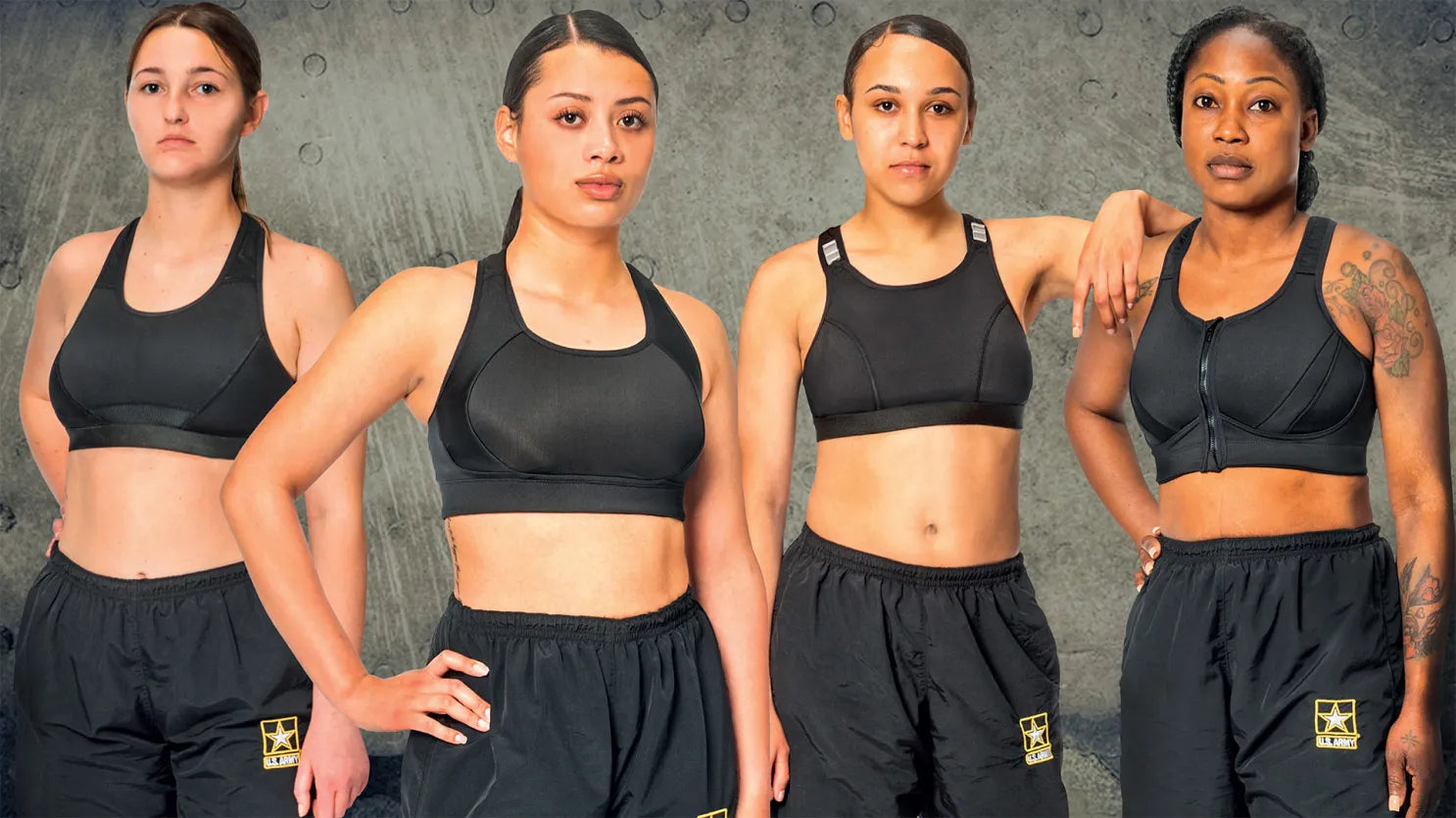
The Breast Support System (BSS) addresses the underlying biomechanical problem from the inside out. Where a standard commercial bra, or no bra at all, leaves breast tissue unsupported against a compressive plate, the BSS provides a high-support foundation that stabilises breast tissue before the armour is even put on. The University of Portsmouth Research Group in Breast Health confirmed a 74% reduction in overall breast movement during high-impact activity, the highest result in a comparative test of 60 competitors across 720 trials.
Critically, the BSS was not designed for the gym. It was designed for operational environments:
→ No exposed metal or rigid plastic closures, nothing to create additional pressure points under a plate carrier
→ Padded, non-digging straps engineered to reduce nerve impingement under sustained load carriage
→ Encapsulation and compression combined, each breast stabilised individually, reducing lateral and vertical movement under exertion
→ Hygiene and durability features for multi-day wear without laundering
In body armour trials with female service members, the BSS produced measurable improvements: higher rates of PPE compliance, reduced pain reported during prolonged wear, and reduced chest compression under load. Full trial data is pending publication.
The BSS does not replace the need for female-specific armour. The plate geometry problem still needs to be solved at the armour level. But it closes the gap that exists between what armour can currently do and what a female body needs, and it does so with equipment that can be integrated into standard kit procurement immediately, without waiting for a new armour design to clear certification.
The Operational Conclusion
Every physiological effect described in this article is preventable. Restricted breathing, breast tissue compression, nerve impingement, postural fatigue, long-term musculoskeletal injury - none of these are inevitable consequences of female service. They are consequences of female service in male equipment.
The science is not ambiguous, and the solutions are not experimental. What remains is a procurement system that has not yet caught up with the operational reality it is supposed to serve.
That needs to change.

Share this blog:
Ukrainian Female Military Units: Who They Are, What They Do, and What They Face
Ukrainian Policewomen: Serving Under Fire, Recognised on the World Stage