

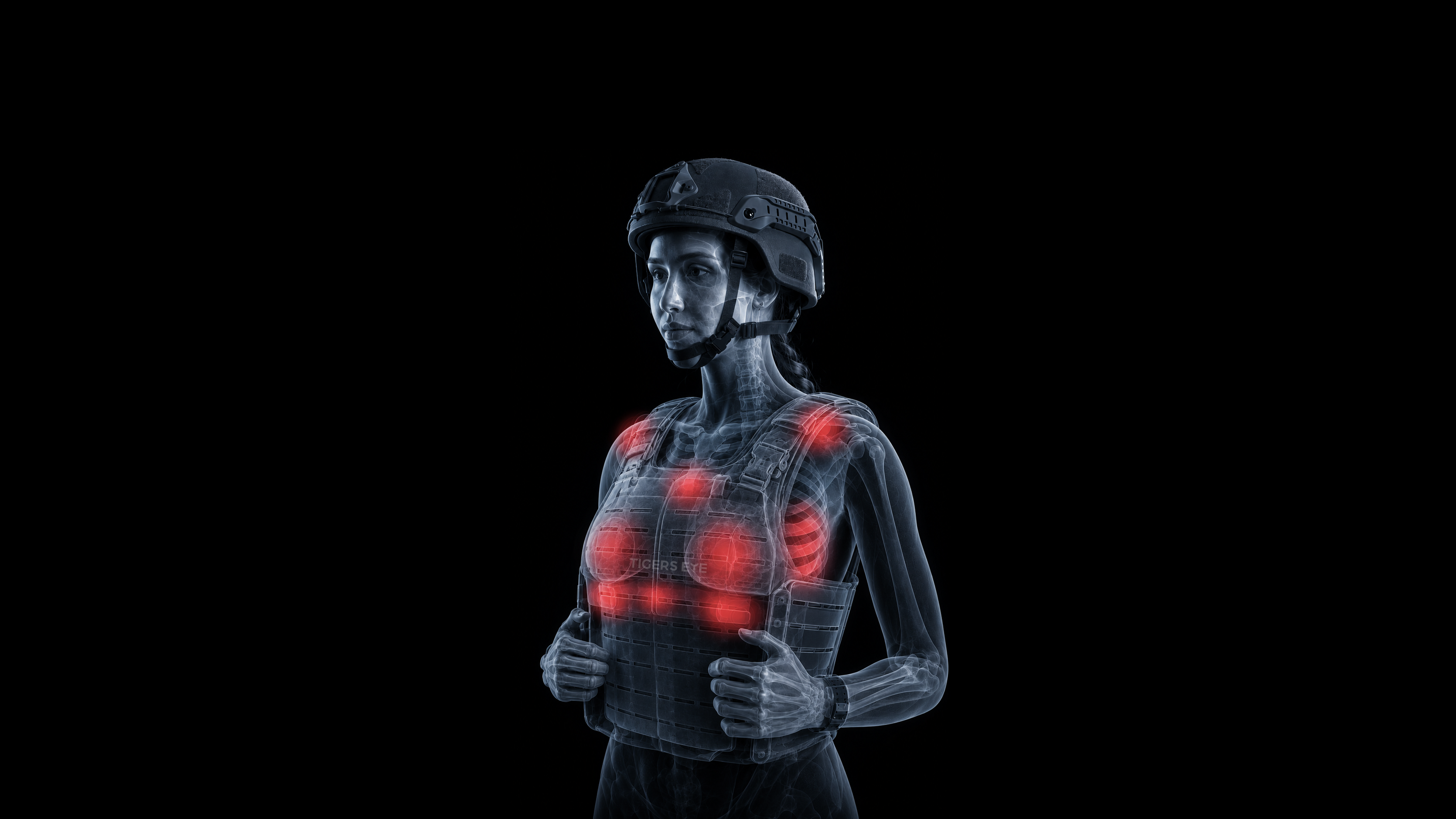
Migraines, nerve damage causing numb fingertips, back, neck and shoulder pain, breast disease, musculoskeletal injuries, anterior cruciate ligament (ACL) injuries, hip and knee stress fractures – these are all things that servicewomen suffer from, which also cause billions of dollars in disability compensation. Treated separately, these look like a list of unrelated problems affecting servicewomen at disproportionate rates. However, after reviewing extensive literature, we concluded that they are in fact not unrelated at all. They share a single point of origin that rarely gets named directly: breasts, and the fact that no piece of standard-issue kit was ever built to account for them.
To be clear, this is not a claim that breasts are the only problem servicewomen face, or that every issue below has a single proven cause. It is a claim that the research, read together rather than one study at a time, points overwhelmingly in one direction – and that direction has been sitting in plain sight, unaddressed, for decades.
Why Breasts Are Different, and Why That Difference Matters
Let’s start with the basic biology, because it explains everything that follows. Breasts are the most visible physical difference between the male and female body. This is not a biomechanics finding that required a laboratory to uncover – it is observable without any testing at all. And yet almost none of the equipment engineered for military, police, and emergency service use has ever been designed around it.
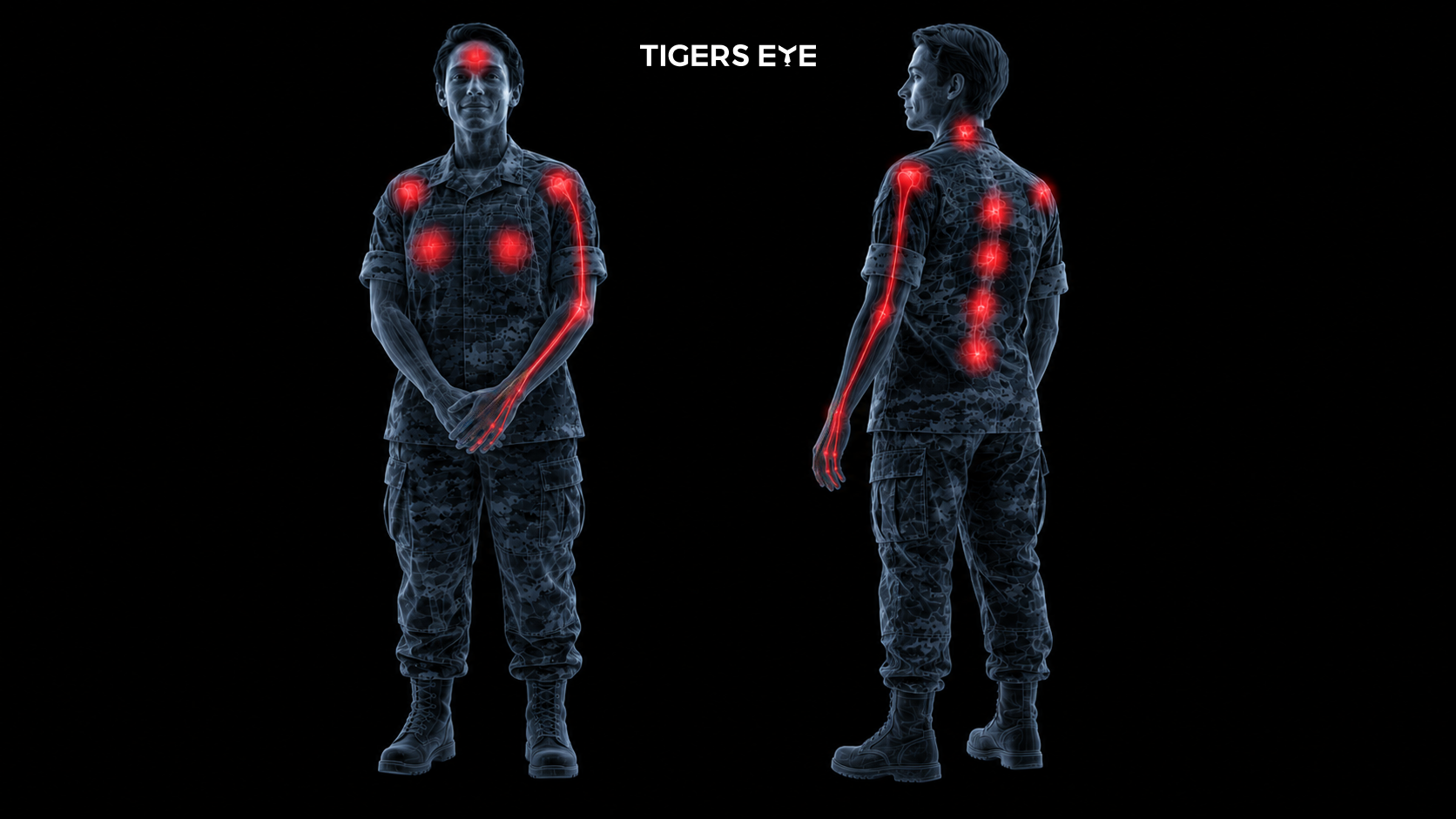
Male and female musculoskeletal system – Observe the obvious external differences
Every consequence in this article – performance, health, financial – starts here.
The Problem Isn't Going Away, Because Women Aren't
The truth is, whether or not anyone is comfortable with it, women are in the military, in policing, and in frontline emergency services to stay, and their numbers are growing. In the UK, the Women in Defence Charter – backed by more than 50 defence-sector employers including the Ministry of Defence – has set a target of 30% female recruitment at entry level by 2030, up from roughly 12% today (Forces News, 2024). That is not an aspiration pulled from nowhere; it is a formally adopted industry target.
Ukraine offers the starkest illustration of where this is heading. For the first time, we are seeing women fight in infantry and front-line combat roles at the same level as men, not in support functions but in direct combat. More than 70,000 women (Sen, 2026) have enlisted in Ukraine's military since the start of the full-scale invasion, with thousands now serving directly in combat roles, operating drones, driving armoured vehicles, and holding front-line infantry positions.
In late 2025, after her unit destroyed a Russian howitzer, the commander of Ukraine's first entirely female national guard crew told the Washington Post: “We won’t win this war without women” (O’Grady et al., 2025). Tigers Eye has worked directly with servicewomen in that same conversation – they wear the Tigers Eye BSS, a detail we mention not to claim credit for what these women have done, but because it underlines how directly this equipment question sits inside their day-to-day reality.

The Washington Post: 'We won't win this war without women'
It also isn’t just about combat exposure – it’s about the equipment those women are given. Ukrainian frontline units are now field-testing curved, female-specific body armour for the first time (CBC News, 2026), a direct acknowledgement that the flat, male-pattern plates issued until now do not fit – and, as the next section covers, that mismatch has a very specific anatomical cause.
However, none of the servicewomen we have so far interviewed has mentioned ever seeing this female-specific armour. View our exclusive interviews here.
Kit Built for a Body That Isn't Theirs
Military and law enforcement equipment such as body armour, load-bearing vests, packs, was designed using male anthropometric data: male chest-to-shoulder ratios, male torso length, male shoulder width (Coltman et al., 2021b). That is a historical problem that has not been corrected. It is the current default. Where female-specific alternatives don’t exist or haven’t been issued, servicewomen are left with two options: source and pay for their own better-fitting equipment where regulations allow it, as some Ukrainian servicewomen have had to do (see here), or wear standard-issue kit built for a body that isn’t theirs and suffer the consequences.

Example of standard-issue (flat) body armour
Those consequences fall into three categories: performance, health, and financial, and every one of them connects back to the same unresolved variable: breast support and the lack of female-specific equipment.
01. Health: Preventable Injury
This is the largest and most well-documented category, and the throughline is consistent: when breast tissue isn't supported, and when equipment isn't built to accommodate it, the damage doesn't stay contained to the chest.
Breast injury and compression
Research on Australian Defence Force servicewomen found that a substantial majority of women wearing body armour report their breasts being crushed or compressed by the plate, with a high proportion reporting discomfort and outright injury during wear (Coltman et al., 2021a). A separate, UK-specific study of British Army recruits found 79% reported at least one breast or bra-related issue before Basic Training even began, rising to 88% during training – and that this did not improve after a professional bra-fitting service was introduced (Burbage et al., 2021), showing that access to fitting alone isn’t the fix; the product itself has to be built for the job.
Cooper’s ligament damage and long-term injury
As covered above, this tissue does not repair itself once damaged. Sustained compression and repeated impact from body armour causes progressive, irreversible change. This has been medically documented, not just theorised: Ukrainian servicewoman Natalia Lishchyshena sustained a hematoma from a fall in her body armour, and was later diagnosed with intraductal breast papilloma; she underwent a double mastectomy, becoming the first servicewoman in Ukraine to have a military medical board officially recognise this condition as connected to her service (Amnesty International, 2026). Another Ukrainian servicewoman, Oleksandra, developed a hematoma in her breast from the same mechanism (Instagram, 2026).
False positives on breast cancer screening
Research led by Professor Wakefield-Scurr found that repeated impact and injury to breast tissue can produce fat necrosis and calcified lumps that are difficult to distinguish from breast cancer on a mammogram – triggering unnecessary biopsies, anxiety, and further invasive investigation (Wakefield-Scurr et al., 2024), not to mention the days off service required for medical appointments. It is important to be precise here: this research, along with Cancer Research UK, is explicit that breast trauma does not cause cancer. What it does cause is tissue changes that can mimic it on screening, complicating a servicewoman’s future breast health monitoring in a way that has nothing to do with her actual cancer risk and everything to do with unaddressed physical trauma.
Nerve impingement, migraines, and shoulder/neck/back pain
Shoulder straps sized for male shoulder width and trapezius mass sit incorrectly on a narrower female frame, compressing the trapezius nerve bundle. This causes numbness and tingling in the shoulder, arm, and hand, and is separately linked to tension-driven migraines through neck and shoulder strain. This mechanism is our own descriptive explanation of a widely reported pattern and anecdotal evidence rather than a single cited clinical study, as further specific research is needed to confirm this. Separately, nearly a third of female veterans report a lifetime history of migraines – close to four times the rate reported by men (Gasperi et al., 2024). This gap that is not yet proven to be gear-caused, but it sits inside a system where every other piece of evidence points toward equipment as a contributing factor.
More on servicewomen & migraines:
Musculoskeletal injury, hips, and knees
Female service members carry a 25–29% higher risk of musculoskeletal injury than male service members (Colahan et al., 2024). Biomechanics research shows why breast support specifically factors into this: inadequate support increases impact force through the body during running (White et al., 2009), alters pelvis and trunk movement mechanics (Milligan et al., 2015), and produces knee movement patterns already linked to increased ACL injury risk (Fong et al., 2022). Poor breast support is not separate from lower-limb injury — it is one of the documented mechanisms driving it. Hip and pelvic stress fractures occur at dramatically higher rates in military women than men, with women under 20 experiencing acute hip fractures at 4.7 times and hip stress fractures at 6.8 times the rate of men the same age (Vu et al., 2024).
Every one of these conditions has, at some point, been treated by procurement systems as a separate problem requiring a separate fix. The research doesn't support treating them separately. It supports treating them as downstream effects of the same unaddressed cause: the lack of breast support integration into standard-issue kit.
02. Performance: Mission Compromised
The performance cost of inadequate breast support is the least talked about because it doesn't look like an injury and it requires biomechanics testing for confirmation. It does, however, look like someone running slightly slower, tiring faster, or hesitating for a second at the wrong moment. In any operational environment, those seconds could be the difference between life and death.
Stride length and endurance
Research from Brooks Running conducted with the University of Portsmouth’s Research Group in Breast Health, led by Professor Joanna Wakefield-Scurr, found that poorly controlled breast movement can reduce stride length by up to 4cm per stride (runABC, 2021). Over the distance of 26 miles, that adds up to running the equivalent of an extra mile. Over a 20+ mile loaded march in full kit, the compounding effect on fatigue and completion time is significant.
Oxygen consumption
Separately, researchers at the University of Memphis’s Breast Biomechanics Research Center found that runners in high-support conditions consumed 6.9% less oxygen than in low-support conditions, with a corresponding improvement in running economy (Fong & Powell, 2022). While this sounds negative, in aerobic performances such as running, consuming more oxygen means an unsupported female body is using up more, working harder to do the same job, which also leads to early fatigue. In addition, in operational environments that involve oxygen tanks, oxygen efficiency is crucial; consuming more might mean swapping members out more often, which can slow down a mission and can possibly create life threatening emergency situations.
Restricted breathing
A flat chest plate pressing against unsupported breast tissue restricts normal chest wall expansion. Body armour and load carriage have been shown to impair respiratory function during sustained physical tasks in female soldiers specifically (Armstrong et al., 2017). The body compensates with less efficient diaphragmatic breathing, accelerating fatigue over sustained 8-to-24-hour operational periods. A long military shift might already require sleep deprivation; adding an extra layer of early fatigue affects concentration and overall physical performance significantly.
Weapon handling
This is where the health consequences we covered above stop being abstract and become operational. Breast tissue that isn’t properly supported and controlled physically interferes with shouldering a rifle correctly and maintaining a stable firing position (real combat experience of this problem is described here).
Additionally, nerve impingement from poorly designed straps – covered in detail above – causes numbness and reduced fine motor control in the hand and fingers, directly affecting grip and trigger control. And migraines, discussed above, potentially present with visual aura and temporary tunnel vision, which is not just a minor inconvenience for anyone whose job depends on accurate target acquisition and situational awareness. This paragraph is our own analysis, connecting the health findings above to their tactical consequences. Although this is not drawn from a single study, the connection is staggering and should make anyone think twice before dismissing breasts as a personal matter for servicewomen to handle at their own discretion – and rather make specialised breast support an operational requirement.
03. Financial: Avoidable Liability
The cost of getting this wrong doesn't disappear when a servicewoman's career ends. It not only follows her through medical costs, but it also lands on public budgets.
In the financial year 2021 alone, lower-extremity injuries in female service members accounted for more than 494,000 healthcare encounters and cost $30.6 million in private-sector care alone – and this is not counting on-base treatment, which wasn’t even being tracked in this data (Colahan et al., 2024). That figure covers only one injury category, in just one year.
Zoomed out further, female veterans received roughly $20 billion in total VA disability compensation in a recent fiscal year, and nearly 29% of female compensation recipients are rated at the most severe, 100% disability level – a higher proportion than male recipients (Veterans Benefits Administration, 2025). Musculoskeletal conditions, including neck, shoulder, and back injuries of exactly the kind described above, are consistently among the most common categories driving these ratings. Our own analysis of this data estimates the musculoskeletal-specific share of that compensation at approximately $8.6 billion annually (Tigers Eye Critical Services, 2026, based on Veterans Benefits Administration, 2025) — a figure calculated internally rather than a single quoted line within the report, since the report does not publish one combined dollar total for this category.
This is not a cost that appears only in exceptional cases. It compounds across a full career, through healthcare utilisation, lost duty days, reduced retention, and disability payments that continue for decades after service ends – for a set of injuries that the research increasingly shows are preventable with the right equipment, not inevitable.
The Common Thread
Read individually, migraines, back pain, nerve damage, breast tissue injury, hip fractures, and billions of dollars in compensation look like a list of disconnected problems. Read together, they describe one system failing in a consistent, predictable way: equipment engineered for a body that doesn't move, breathe, or carry load the way a servicewoman's body does, with breast tissue as the specific point where that mismatch originates and radiates outward.
This is not to claim that better breast support would eliminate all of these problems. But it is a claim, supported by a genuinely large body of research across militaries, police forces, and independent biomechanics labs, that breast support is not the personal, private, comfort-only issue it has historically been treated as. It is operational equipment, and the evidence shows it belongs in the same conversation as body armour, boots, and packs.
Tigers Eye exists to close exactly this gap: not by replacing the case for better-fitting armour, packs, and uniforms, which still needs to happen, but by addressing the one piece of the system that sits closest to the body and has been left out of the conversation the longest: specialised breast support.
The research is no longer ambiguous. What's missing is a procurement system and a public conversation that treats breast support as what the data already shows it to be: not a women's issue, an operational one.
Enquire about integrating the BSS into your equipment programme →
References
Amnesty International. (2026). Natalia Lishchyshena on fighting for recognition and change. https://www.amnesty.org/en/latest/campaigns/2026/05/natalia-lishchyshena-on-fighting-for-recognition-and-change/
Armstrong, N., Risius, D., Wardle, S., Greeves, J., & House, J. R. (2017). The effects of body armour and load carriage on respiratory function and physical performance during a simulated military task in male and female soldiers. Journal of Science and Medicine in Sport, 20, S75. https://doi.org/10.1016/j.jsams.2017.09.173
Burbage, J., Rawcliffe, A. J., Saunders, S., Corfield, L., & Izard, R. (2021). The incidence of breast health issues and the efficacy of a sports bra fit and issue service in British Army recruits. Ergonomics, 64(8), 1052–1061. https://doi.org/10.1080/00140139.2021.1895324
CBC News. (2026, August 2). On Ukraine’s front lines, female soldiers testing Canadian-designed body armour. https://www.cbc.ca/news/world/ukraine-body-armour-designed-for-women-9.7292202
Colahan, C., Pav, V., Yuan, X., Isaacson, B., Wagner, L., & Hando, B. (2024). Musculoskeletal injuries in female U.S. active duty service members: Prevalence/incidence, health care utilization, and cost analysis spanning fiscal years 2016–2021. Military Medicine, 189(Suppl 4), 10–21. https://doi.org/10.1093/milmed/usae308
Coltman, C. E., Brisbine, B. R., & Steele, J. R. (2021a). Bra-body armour integration, breast discomfort and breast injury associated with wearing body armour. Ergonomics. https://doi.org/10.1080/00140139.2021.1951849
Coltman, C. E., Brisbine, B. R., Molloy, R. H., Ball, N. B., Spratford, W. A., & Steele, J. R. (2021b). Identifying problems that female soldiers experience with current-issue body armour. Applied Ergonomics, 94, 103384. https://doi.org/10.1016/j.apergo.2021.103384
Forces News. (2021, September 16). Armed Forces aims for 30% female recruits by 2030. https://www.forcesnews.com/news/armed-forces-aim-30-female-recruits-2030
Fong, H. B., Nelson, A. K., Storey, J. E., Hinton, J., Puppa, M., McGhee, D., Greenwood, D., & Powell, D. W. (2022). Greater breast support alters trunk and knee joint biomechanics commonly associated with anterior cruciate ligament injury. Frontiers in Sports and Active Living, 4, Article 861553. https://doi.org/10.3389/fspor.2022.861553
Fong, H. B., & Powell, D. W. (2022). Greater breast support is associated with reduced oxygen consumption and greater running economy during a treadmill running task. Frontiers in Sports and Active Living, 4, Article 902276. https://doi.org/10.3389/fspor.2022.902276
Gasperi, M., Schuster, N. M., Franklin, B., Nievergelt, C. M., Stein, M. B., & Afari, N. (2024). JAMA Network Open, 7(3), e242299. https://doi.org/10.1001/jamanetworkopen.2024.2299
Instagram [@tigerseyecriticalservices]. (2026). Oleksandra’s account of body armour-related breast injury [Video]. https://www.instagram.com/reel/DVwOORHjymn/
McGhee, D. E., & Steele, J. R. (2020). Breast biomechanics: What do we really know? Physiology, 35(2), 144–156. https://doi.org/10.1152/physiol.00024.2019
Milligan, A., Mills, C., Corbett, J., & Scurr, J. (2015). The influence of breast support on torso, pelvis and arm kinematics during a five kilometer treadmill run. Human Movement Science, 42, 246–260. https://doi.org/10.1016/j.humov.2015.05.008
O’Grady, S., Khudov, K., & Parafeniuk, O. (2025, November 28). “We won’t win this war without women”: Ukraine’s first all-female drone unit joins the fight against Russia. The Washington Post. https://www.washingtonpost.com/world/interactive/2025/ukraine-women-combat-drone-unit/
runABC. (2021, March 17). Underwear is under investigation: Elite female athletes to benefit from latest sportswear innovations. https://runabc.co.uk/breast-health-research-results-in-support-for-elite-athletes
Sen, V. (2026, April 6). 70,000 women in Ukraine's armed forces: A war that reshaped roles and responsibilities. Transatlantic Dialogue Center. https://tdcenter.org/2026/04/06/70000-women-ukraine-armed-forces-el-heraldo/
Tigers Eye Critical Services. (2026). Internal analysis of musculoskeletal-related disability compensation for female veterans, derived from Veterans Benefits Administration (2025) [Unpublished internal calculation].
Veterans Benefits Administration. (2025). Annual benefits report: Fiscal year 2025. U.S. Department of Veterans Affairs. https://www.benefits.va.gov/REPORTS/abr/docs/2025-abr.pdf
Vu, P. A., Stahlman, S. L., Fan, M. T., & Wells, N. Y. (2024). Incidence and risk factors for hip fractures among U.S. Armed Forces active component women compared to men, 2018–2022. Medical Surveillance Monthly Report, 31(8), 8–13. https://pmc.ncbi.nlm.nih.gov/articles/PMC11413133/
Wakefield-Scurr, J., St John, E., Bibby, K., Renwick, N., Smith, N., Hobbs, S., & Brown, N. (2024). Insights into breast health issues in women’s rugby. European Journal of Sport Science. https://doi.org/10.1002/ejsc.12128
White, J. L., Scurr, J. C., & Smith, N. A. (2009). The effect of breast support on kinetics during overground running performance. Ergonomics, 52(4), 492–498. https://doi.org/10.1080/00140130802707907
Share this blog:
The $30.6 Million Question: What Breast Support Has to Do With Hip and Knee Injuries in Servicewomen
Why sports bras are not good enough for servicewomen