

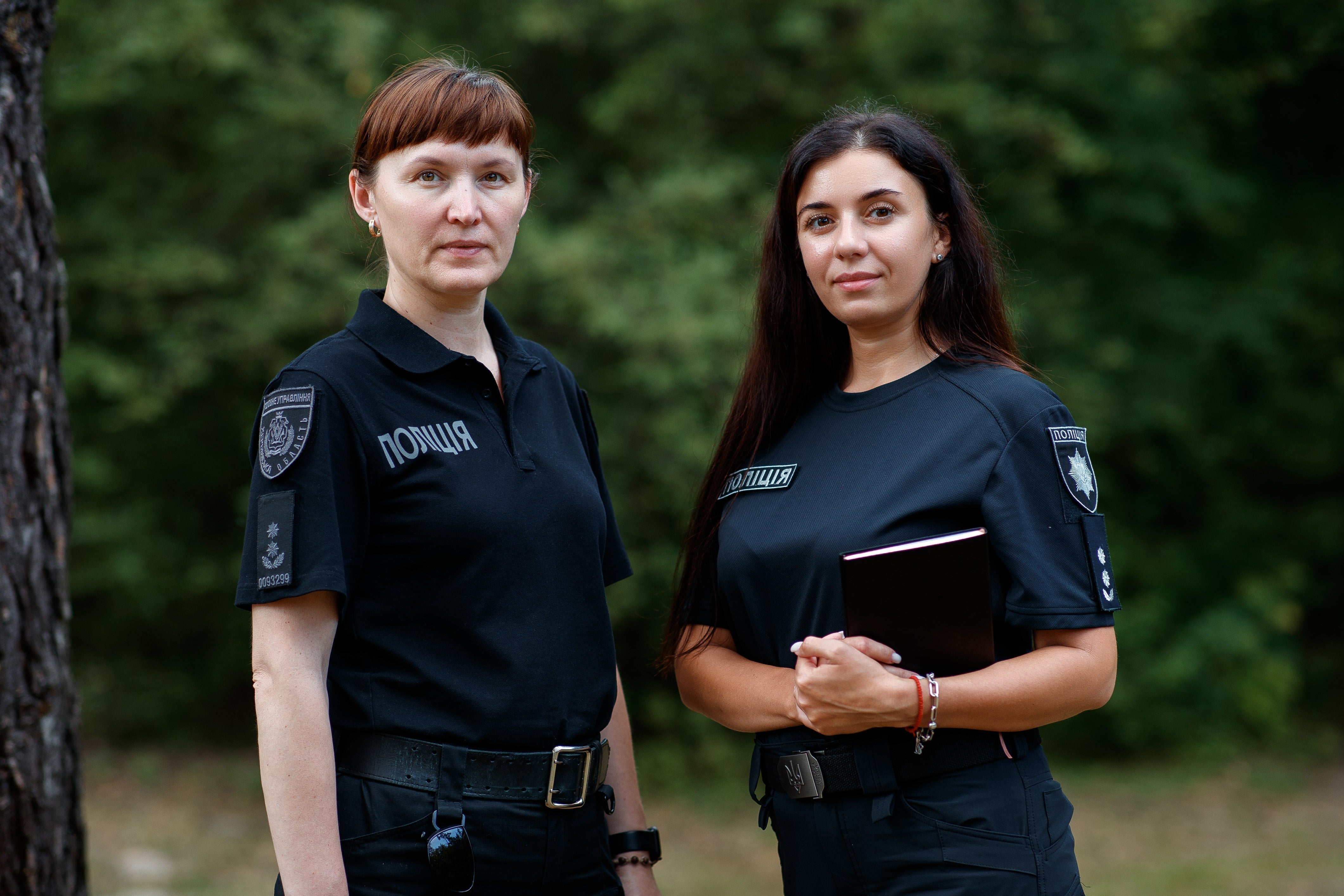
There is a version of this story that focuses on the numbers. Twenty-seven per cent (27%) of the National Police of Ukraine are women. Over 600 are members of the Ukrainian Association of Women in Law Enforcement. Dozens have received international recognition for their conduct under conditions that most police forces anywhere in the world will never face.
But the numbers don't capture what these women actually did when the war came around.
When the Police Became the Frontline
On 24 February 2022, the day Russia launched its full-scale invasion of Ukraine, police officers across the country did not evacuate. They stayed in cities under bombardment, in towns that would become occupied territory, in regions where the front line moved through streets they had patrolled for years. Ukrainian police officers, women among them, continued to work.
In Mariupol, officers remained as the city fell under siege. In Bucha, police documented evidence of atrocities. In Sumy, a unit of female officers coordinated the rescue of children caught in the crossfire between Russian and Ukrainian forces, an operation later reported by Radio Free Europe/Radio Liberty that drew international attention not just for its success, but for the fact that it was carried out by women operating under active fire.
These were not office roles. They were operational, dangerous, and carried out with equipment designed for male officers.
International Recognition
In recent years, Ukrainian policewomen have received some of the highest recognition available in international law enforcement.
At the International Association of Women Police (IAWP) conference held in Glasgow, Ukrainian officers were formally honoured for their service during the war. The IAWP, which represents women in policing across more than 80 countries, recognised specific individuals for conduct that exemplified professionalism and courage under extraordinary circumstances.
Among those recognised was a Captain whose service during the war drew attention at the conference and beyond, her story becoming part of a broader conversation about what women in law enforcement - and therefore all services - are capable of when given the opportunity and, critically, the support to do their jobs.
The Ukrainian Association of Women in Law Enforcement (UAWLE), with over 600 members, has played a key role in documenting the contributions of women in the national police and advocating for conditions that allow them to serve effectively. Their work has provided some of the most important evidence of both the capability and the unmet needs of women in Ukrainian law enforcement.
The Equipment Problem in Policing
The equipment problem facing military women in Ukraine exists in parallel form in law enforcement, and it is, if anything, less discussed.
Female police officers are issued standard body armour designed for male officers. The same dynamics apply: the chest plate does not sit flat on a female torso, the weight distribution is wrong, and the straps are designed for a male shoulder and chest width. The result is reduced mobility, increased discomfort (chafing, irritation, breast compression, etc.) and pain during prolonged wear, and elevated injury risk.
Unlike the military, where surveys have begun to document this systematically, policing data on the impact of ill-fitting PPE on female officers is largely absent.
What exists is anecdotal, but the anecdotes are consistent. Female officers describe adjusting their armour constantly during shifts, wearing it less than they should because of the discomfort – therefore risking their safety - and in some cases leaving it off entirely in lower-risk situations because the sustained pain of wearing it outweighs the perceived benefit.
That last point is the one that matters most to force commanders: if body armour is causing enough discomfort to reduce compliance, the protective equipment is failing at its primary purpose.
The BSS in Police Trials
Tigers Eye has been involved in body armour trials with police forces in the UK, providing the Breast Support System (BSS) for female officers to wear underneath their standard-issue vests.
The feedback from those trials mirrors what has been reported from military contexts: higher PPE compliance, reduced pain during prolonged wear, and reduced sense of chest compression during physical exertion. Officers reported that wearing the BSS underneath their vest changed how the armour sat on their body and reduced the specific pressure points that had previously made extended wear difficult.
The full results of those trials are pending publication. But the direction of travel is clear: properly designed breast support, integrated into the PPE system rather than left to individuals to source themselves, changes how female officers wear and tolerate their protective equipment.
A Global Conversation
Ukraine's policewomen did not ask to become a case study in women's operational capability. They became one because a war came to their country, and they chose to stay and fight.
What their experience demonstrates, alongside the recognition of the IAWP, the documentation of the UAWLE, and the evidence emerging from trial programmes, is that women in law enforcement are operating at the highest level in the most demanding conditions. And they are doing it with equipment that was not designed for them, which ultimately puts operations and personal safety at risk.
The conversation about female-specific PPE in policing is still in its early stages. Ukraine has, in the most difficult way possible, pushed that conversation forward.
The question for police forces in the UK, the US, and elsewhere is whether they are willing to learn from it before their own officers pay the same price.
Share this blog:
What Body Armour Does to the Female Body: The Science
The Army Tactical Brassiere vs. The BSS: Where Government R&D Stopped and Commercial Innovation Started