

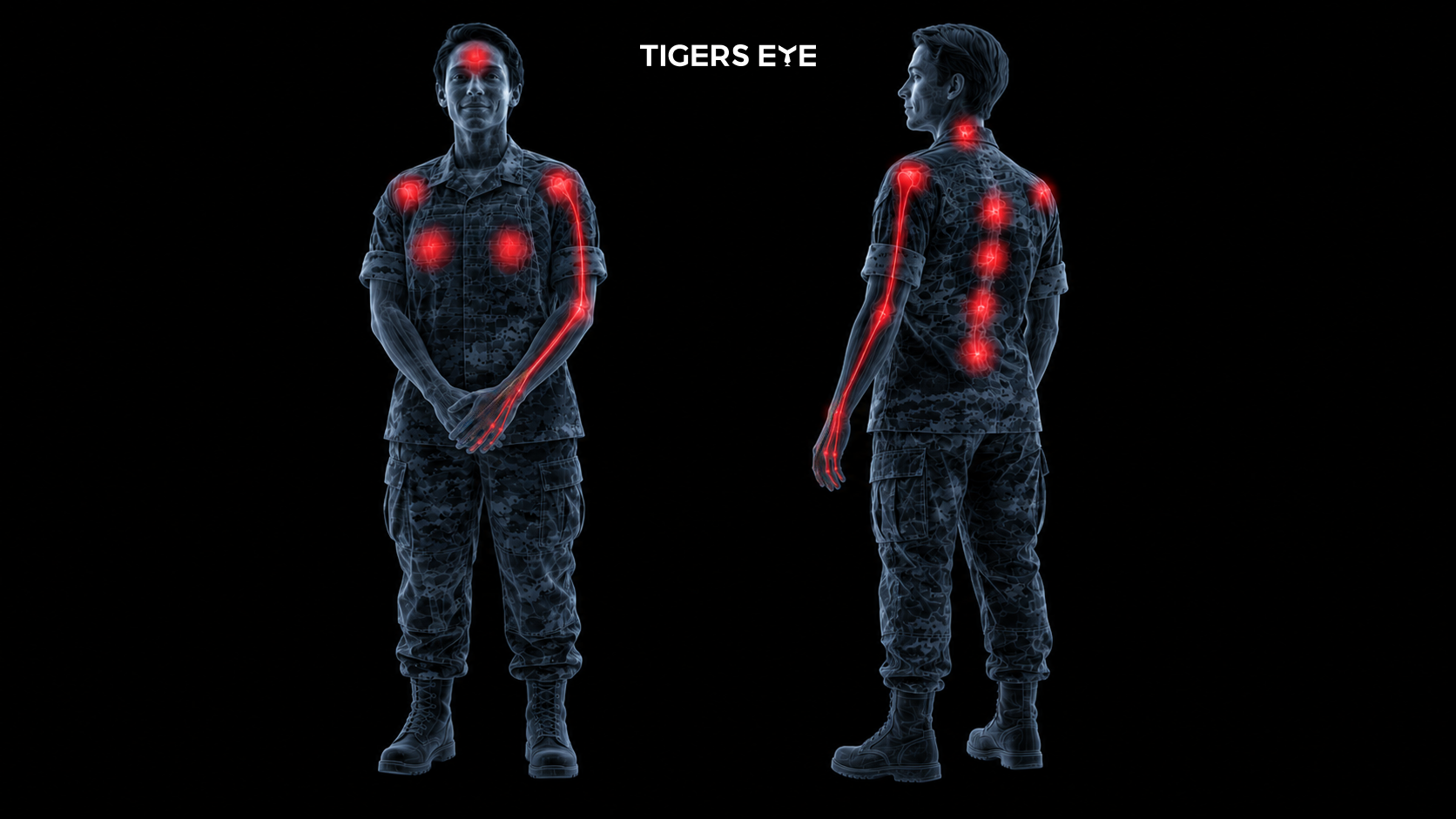
Musculoskeletal injuries among female service members are not just an individual health concern. They are a readiness, healthcare, and public cost issue.
The Research
A large U.S. military study covering fiscal years 2016–2021 found that female active-duty service members had a 25%–29% higher risk of musculoskeletal injury than male service members (Colahan et al., 2024). In FY2021 alone:
· one in three female service members experienced lower-extremity injuries
· nearly one in four experienced spine injuries
· lower-extremity injuries alone accounted for more than 494,000 healthcare encounters and cost $30.6 million in private-sector care
These numbers show that injury prevention cannot stop at training programs, medical treatment, or physical conditioning. It must also include the gear women wear every day.
The Female Anatomy Difference
For women in the military, a bra is not simply underwear. It is part of the equipment system. During running, marching, load carriage, crawling, jumping, and body armour wear, breast support can affect comfort, movement, posture, skin integrity, concentration, confidence, performance, and injury risk.
How Breast Support Affects the Whole Body
This is not just anecdotal. Biomechanics research shows that inadequate breast support increases impact force through the body during running (White, Scurr, & Smith, 2009), alters pelvis and trunk movement mechanics during running (Milligan et al., 2015), and - in landing tasks - produces the same knee valgus pattern already linked to increased risk of anterior cruciate ligament (ACL) injury (Fong et al., 2022).
Separately, research on load carriage shows that women's hips and knees already respond differently to carried load than men's, stiffening rather than moving more as load increases (Loverro et al., 2019), meaning kit built around male movement patterns starts from the wrong baseline before breast support is even factored in. Together, this research connects breast support to the same kinetic chain implicated in the lower-extremity injuries described above.
In plain terms: when breasts aren't properly supported, they move more with every stride. That extra movement translates into extra force hitting the ground harder with each foot strike, and that added impact has to go somewhere. Research shows it travels through the same hips and knees already linked to lower-limb injury, changing posture, stride, and landing mechanics along the way.
Body Armour Wasn't Built for Women's Hips Either
Body armour compounds the problem. Reviews of female load carriage have found that armour built around male proportions often fails to accommodate women's breasts and hips; in one documented case, looseness around the waist in body armour stopped a pack's waist belt from cinching properly, shifting load away from the pelvis and onto the shoulders and spine in a way the equipment wasn't designed for (Johnson et al., 2021). Poor fit also forces compensations in stride, including overstriding, which places additional shearing stress directly on the pelvis (Johnson et al., 2021). This may help explain why hip and pelvic stress fractures occur at consistently higher rates in military women than men. Women under 20 experience acute hip fractures at 4.7 times and hip stress fractures at 6.8 times the rate of men the same age (Vu et al., 2024).
The Bottom Line
When breast support fails, the body doesn't just tolerate more movement at the chest. It hits the ground harder with every step, absorbs more force through the hips and knees, and adjusts posture and stride in ways connected to greater injury risk. Poor breast support is not separate from lower-limb injury in servicewomen; it is one of the mechanisms driving it.
When gear is not designed for women's bodies, the impact goes beyond discomfort. Poorly fitted and inappropriate support bras can contribute to pain, chafing, distraction, restricted movement, altered lower-body movement patterns, reduced training participation, and avoidable physical stress. In demanding military environments, these issues can affect not only the individual service member but also unit readiness, healthcare systems, public spending, employers, families, and society.
This is why breast support should be treated as essential performance gear, not as a private women's issue.
Where Tigers Eye Fits In
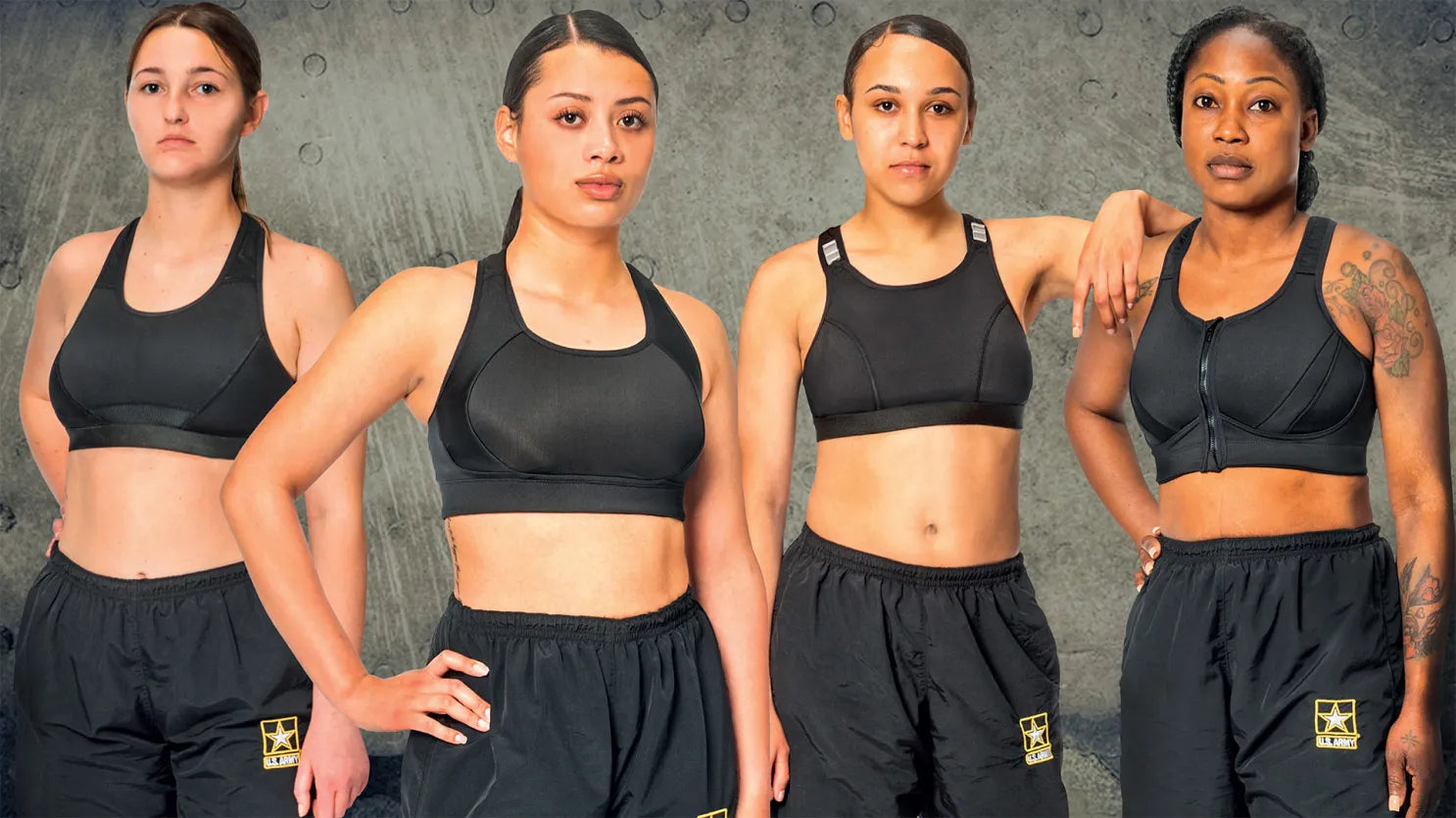
The Tigers Eye bra fits into this conversation by addressing one overlooked part of the gear gap: the need for breast support specifically designed for servicewomen's movement, high-impact activity, and demanding environments in mind. A military-ready bra should provide secure support, reduce unnecessary movement, minimise chafing, remain comfortable under layers or body armour, and help women perform without constantly adjusting, compensating, or enduring pain.
Better bras will not eliminate musculoskeletal injuries completely, but they can remove one avoidable source of discomfort and help women train, move, and serve with fewer barriers. The research shows that it might also help reduce injury risk or severity, which for servicewomen, could be the difference between staying in the service or medical retired with musculoskeletal disabilities. Therefore, proper breast support is worth investing in!
The Bigger Picture
Investing in appropriate gear for women is not only about comfort. It is about prevention, performance, retention, readiness, and responsible use of public resources.
When women's gear fails, the cost is not carried by women alone. It is carried by the whole system.
References
Colahan, Courtney, Veronika Pav, Xiaoning Yuan, Brad Isaacson, Linzie Wagner, and Ben Hando. “Musculoskeletal Injuries in Female U.S. Active Duty Service Members: Prevalence/Incidence, Health Care Utilization, and Cost Analysis Spanning Fiscal Years 2016–2021.” Military Medicine 189, Supplement 4 (November/December 2024): 10–21. https://doi.org/10.1093/milmed/usae308.
Fong, Hailey B., Alexis K. Nelson, Julie E. Storey, J. Hinton, M. Puppa, D. McGhee, D. Greenwood, and Douglas W. Powell. “Greater Breast Support Alters Trunk and Knee Joint Biomechanics Commonly Associated With Anterior Cruciate Ligament Injury.” Frontiers in Sports and Active Living 4 (2022): 861553. https://doi.org/10.3389/fspor.2022.861553.
Johnson, Venerina, Julia Coyle, Rodney Pope, and Robin M. Orr. “Load Carriage and the Female Soldier.” Journal of Military and Veterans' Health 19, no. 3 (2021). https://doi-ds.org/doilink/11.2021-87169928/JMVH.
Loverro, Kari L., Leah Hasselquist, and Cara L. Lewis. “Females and Males Use Different Hip and Knee Mechanics in Response to Symmetric Military-Relevant Loads.” Journal of Biomechanics 95 (2019): 109280. https://www.sciencedirect.com/science/article/abs/pii/S0021929019304865 .
Milligan, A., C. Mills, J. Corbett, and J. Scurr. “The Influence of Breast Support on Torso, Pelvis and Arm Kinematics During a Five Kilometer Treadmill Run.” Human Movement Science 42 (2015): 246–260. https://doi.org/10.1016/j.humov.2015.05.008.
Vu, Patricia A., Shauna L. Stahlman, Michael T. Fan, and Natalie Y. Wells. “Incidence and Risk Factors for Hip Fractures Among U.S. Armed Forces Active Component Women Compared to Men, 2018–2022.” Medical Surveillance Monthly Report 31, no. 8 (2024): 8–13. https://pmc.ncbi.nlm.nih.gov/articles/PMC11413133/.
White, Jennifer L., Joanna C. Scurr, and Nicola A. Smith. “The Effect of Breast Support on Kinetics During Overground Running Performance.” Ergonomics 52, no. 4 (2009): 492–498. https://doi.org/10.1080/00140130802707907.

Share this blog:
The Army Tactical Brassiere vs. The BSS: Where Government R&D Stopped and Commercial Innovation Started